
SEAI Grants and Planning Permission in Ireland: How to Plan Your Timeline
When considering applying for SEAI grants it is important to understand your planning requirements and how this may impact your timelines.
Generally, provided some specific conditions are met, works to improve the energy efficiency of a home such as attic and wall insulation, a heat pump, rooftop solar panels and replacement windows, do not require planning permission. The difficulty is rarely whether you can do them. It is figuring out the best way to manage the process, the correct order to apply for grants and any planning permissions that are required.
Three separate systems apply to a retrofit: the planning system, the Building Regulations, and the SEAI grant schemes. Each has its own rules and its own clock. Get the sequence wrong — start works before your grant is approved, or apply for a grant before any planning permission is granted — and you can lose the grant entirely, with no route of appeal.
This guide sets out the sequence that keeps everything valid, step by step.
Step 1: Decide Who Is Managing the Project
There are two routes to a grant-aided retrofit, and the choice shapes everything that follows.
The One Stop Shop route. An SEAI-registered One Stop Shop manages the whole project — the home energy assessment, the grant application, the contractors, and the final Building Energy Rating (BER). The grant is deducted from your bill upfront, and the upgrade must bring the house to a BER of B2 or better. This route suits a deep retrofit done in one go.
The self-managed route. You apply for individual grants under the Better Energy Homes scheme, choose your own SEAI-registered contractors, and sequence the measures yourself, one at a time or together. You claim the grant after the works are done.
One thing the One Stop Shop will not do is take responsibility for obtaining any planning permissions required for the proposed upgrades. The selected company will manage the grant and carry out the works. Whether the works are lawful in planning terms remains your problem. This is why seeking certainty around whether planning permission is needed is the next priority, whichever management route you choose.
Step 2: Check the Planning Position of Each Measure
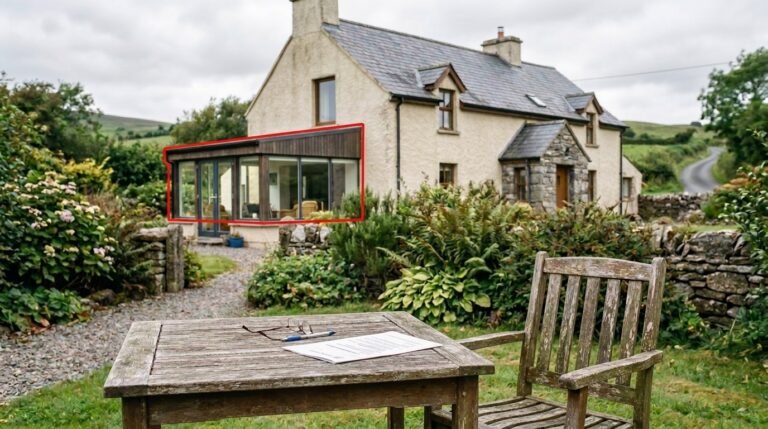
Most retrofit measures are exempted development, meaning no planning application is needed. However, each exemption has conditions, and a few measures sit in greyer territory. Built heritage protection measures and planning conditions could take all of these specific exemptions, and most other planning exemptions, off the table:
- Protected structures. Any works that affect the character of a protected structure require planning permission, including works that would otherwise be exempt. If your home is a protected structure, a conservation architect should be your first call.
- Architectural Conservation Areas (ACAs) and planning conditions. Inside an ACA, works to the exterior need permission where they would affect the character of the area. Also check your local Development Plan and the planning history of the property for any conditions that might prohibit some of these upgrades.
If none of the above apply to your home the following rules generally apply.
Attic, cavity and internal insulation. Internal works that do not change the external character of the house don’t require planning permission and there is unlikely to be a planning related difficulty with either of these measures.
Rooftop solar panels. Since the 2022 regulations, you can add a large solar panel array to the roof of a house and associated equipment without planning permission. The main condition is that panels must sit at least 50 centimetres from any edge of the roof. The panels must not be elevated above the plane of the roof by 50 centimetres on a flat roof and 15 centimetres on a pitched roof slope. Beyond this the only limits are physical rather than planning related: access, the available roof area and the roof’s orientation to the sun. Solar panels applied to a wall always require planning permission.
Free-standing solar panels in the garden are also exempt, provided they do not exceed 25 square metres, are no more than 2.5 metres high, are not in front of the house, and do not reduce your private open space to the rear or side below 25 square metres.
You may have heard of Solar Safeguarding Zones (SSZ); these limit the size of solar panel arrays in areas around airports and aerodromes where the shiny panels can cause hazardous glare. However, these restrictions apply to commercial buildings with very large solar arrays (over 300m²), and not to homes.
Heat pumps, whether ground or air source heat pumps, require a piece of external plant equipment which is exempt, subject to conditions. The total footprint of the heat pump or heat pump array must not exceed 2.5 square metres, and must not be mounted on the roof. Installation to the front, side or rear of the house is now permitted under SI 338–344 of 2026. The heat pump must be spaced a minimum of 50 centimetres from the edge of the wall or roof on which it is mounted. The noise emissions from the heat pump at the boundary to the nearest neighbouring dwelling must not exceed 43 decibels during normal operation. In practice, the noise condition wording can complicate the planning picture and determine the position of the heat pump within your garden. The noise is measured at the boundary with your neighbour rather than at their bedroom windows which can be restrictive as noise levels drop off with distance.
Modern air source heat pumps can typically run at anywhere from 40 to 55 decibels in normal operation. If it ends up too close to a boundary you may be required to add attenuation such as adding a screen, an acoustic enclosure or to increase the size of the heat pump in order to limit it to running in a low noise setting. These are all costly solutions that could be avoided by keeping a reasonable distance from the boundary, but only if you have the space. The services of an acoustic consultant can help you to find the best place to position the heat pump, check expected noise levels at the boundaries based on the model of heat pump selected and set the requirements for any mitigation required.
A specific condition related to ground source heat pumps, is that the ground level cannot be raised by 1 metre relative to the adjacent existing ground level. This restricts building up ground to better accommodate the buried pipework used by ground source heat pumps.
Replacement windows and doors are generally exempt, because swapping windows does not normally affect the external appearance of the house in a way that is inconsistent with its character. However, the character and what constitutes inconsistent is subjective; replacing original timber sash windows with uPVC replicas in a period style house could cross that threshold for many local councils. If in doubt, a Section 5 declaration from your local authority (explained at the end of this article) will settle the question before you place an order.
External wall insulation is an improvement measure most likely to cause planning difficulty. Wrapping the house in insulation and re-rendering inevitably changes its external appearance, and the works are only exempt if the new appearance remains consistent with the character of the house and its neighbours. The relationship between the external walls and the eaves and gable at roof level will change as well as depth of reveals at doors and windows. While this might be subtle in a completely detached house, if neighbouring houses are a similar design and close by to make a visual comparison, it represents a real risk. Insulating a brick-fronted house and finishing it in render is a different proposition, as the change to the character is obvious, and planning permission would certainly be required. And there is a harder limit that catches terraced streets: where the front wall sits directly on the public footpath, external insulation would project over ground you do not own. No exemption saves you there. It would be sensible to always seek written confirmation from the local authority about any proposal for external insulation.
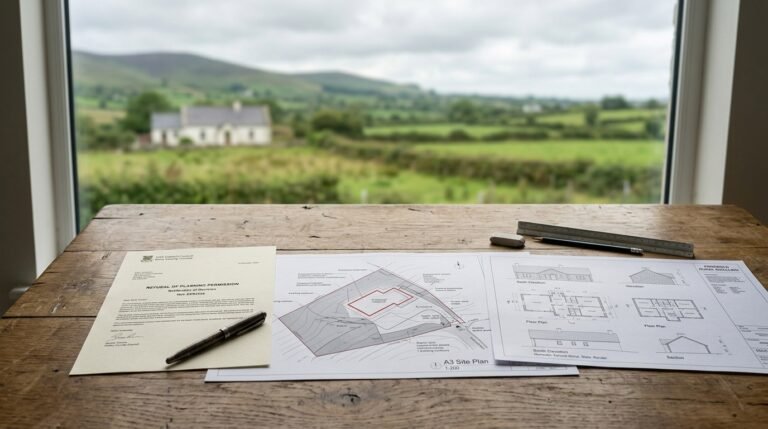
Step 3: If Permission Is Needed, Get It Before You Go Near the Grant
Once SEAI issues a grant offer, you have 30 days to accept it and 8 months to complete the works, obtain a post-works BER, and return the paperwork. That clock does not pause for a planning application.
A planning application takes longer than most people expect. The local authority has 8 weeks to make a decision, but a request for further information restarts much of that period, and a final grant of permission only issues after the 4-week appeal window has passed. In a straightforward case, allow three to four months from application to final grant. With a request for further information or an appeal, considerably longer.
Run those two clocks side by side and the problem is obvious. Apply for the grant while your planning application is still pending, and you could burn half your 8-month window waiting for permission — or worse, hold a grant offer for works you are not yet entitled to carry out.
The correct order is: obtain the planning permission first, then apply for the grant. Do not apply to SEAI until you either know your works are exempt or you hold the planning decision notice.
Step 4: Apply to SEAI — and Do Not Start Works Until Approval Is in Writing
Whichever route you take, the rule is the same: grant approval must be in place before any works begin. Works carried out before approval are not eligible, and SEAI does not make exceptions. Do not let your contractor start on site — not even preparatory work — until you have the written grant offer.
For the self-managed route, you will need: your property’s MPRN (on your electricity bill), the name and ID number of your SEAI-registered contractor, and the year the house was built. Online applications are typically approved within minutes.
Eligibility depends on the age of the house:
- Insulation and windows and doors grants: the home must have been built and occupied before 2011.
- Heat pump and solar grants: built and occupied before 2021.
For a heat pump, there is one extra gate. Homes built before 2007 need a technical assessment confirming the house retains heat well enough for a heat pump to work efficiently — unless a valid BER already shows a heat loss indicator of 2.3 W/(K.m²) or less. A €200 grant covers the assessment (correct as of June 2026), and it must be done before you apply. This is not bureaucracy for its own sake. A heat pump in a leaky house will run constantly and cost you dearly, which is why insulation generally comes first in any sensible retrofit sequence.
SEAI revised its grant values as recently as February and March 2026, so please do check the current figures on seai.ie before you finalise your budget.
Step 5: Building Regulations — and Whether You Need a Commencement Notice
Every retrofit must comply with the Building Regulations in full, whether or not planning permission was needed and whether or not a grant is involved. New windows must meet the required thermal performance, insulation must be properly specified and fixed, and a new heating system must be safely installed.
One requirement deserves particular attention: ventilation. Insulating and sealing a house changes how it breathes. The Building Regulations require adequate ventilation to be maintained, and a competent contractor will assess this as part of the works. Skip it, and the likely result is condensation and mould on the walls you have just paid to insulate.
The formal building control paperwork — the Commencement Notice — is simpler than most homeowners fear:
- If your works are exempt from planning permission, no Commencement Notice is required. Works that are exempted development and do not need a fire safety certificate (houses, unlike apartment buildings, do not) sit outside the notice requirement. Most retrofits fall here.
- If any element of your works needed planning permission, a Commencement Notice is required. It must be lodged electronically through the Building Control Management System (BCMS) not less than 14 days and not more than 28 days before works start, and only after the final grant of permission has issued. The fee is €30.
If you are combining a retrofit with an extension of more than 40 square metres, a more onerous building control regime applies, including an assigned certifier. That is beyond the scope of this article — and a project where you should already have professional advice on board.
Step 6: The Works, the Paperwork and Getting Paid
With approval in writing, the works can start. On the self-managed route, all works must be carried out by an SEAI-registered contractor, and the contractor must give you a safety file on completion. Keep every document.
Within the 8-month window from the grant offer, you must:
- Have the works completed by your registered contractor.
- Get a post-works BER assessment from a registered BER assessor (a €50 grant covers part of the cost).
- Return the signed Declaration of Works and Request for Payment forms to SEAI.
Payment follows within 4 to 6 weeks. SEAI inspects a proportion of grant-aided homes, and if reworks are needed, your contractor must return to site before payment issues.
On the One Stop Shop route, the operator handles all of this, and you simply pay the net bill.
The Timeline at a Glance
- Choose your route — One Stop Shop or self-managed.
- Check the planning position of every measure. If anything needs permission, apply now and wait for the final grant.
- Apply to SEAI only when the planning position is settled. Accept the offer within 30 days.
- Do not start works until grant approval is in writing.
- Lodge a Commencement Notice 14 to 28 days before starting — but only if your works needed planning permission.
- Complete the works, the post-works BER and the paperwork within 8 months of the grant offer.
When to Get Professional Advice
Most straightforward retrofits — insulation, solar panels, a heat pump on a standard house — can follow this timeline without professional planning input. However, you should get advice before committing money if:
- Your house is a protected structure or sits in an Architectural Conservation Area.
- You are considering external wall insulation on anything other than a plain rendered house.
- An earlier planning permission on your property carries conditions.
- You are combining the retrofit with an extension.
If you are unsure whether a measure is exempt, you can apply to your local authority for a Section 5 declaration — a formal, binding determination of whether your proposal needs planning permission. It is a modest fee and a few weeks’ wait, and it is far cheaper than discovering the problem after the render is on. Carrying out works that needed permission without it could leave you in breach of planning law, and may end in a costly retention application — or works being undone — at your own expense.
The grant rules, by contrast, leave no room for argument. Works started before approval are simply not paid for.
This article is general guidance for homeowners in the Republic of Ireland. It is not legal or professional advice, and grant values and scheme rules change. Check the current position with SEAI and your local authority, and get professional advice where your circumstances are not straightforward.