
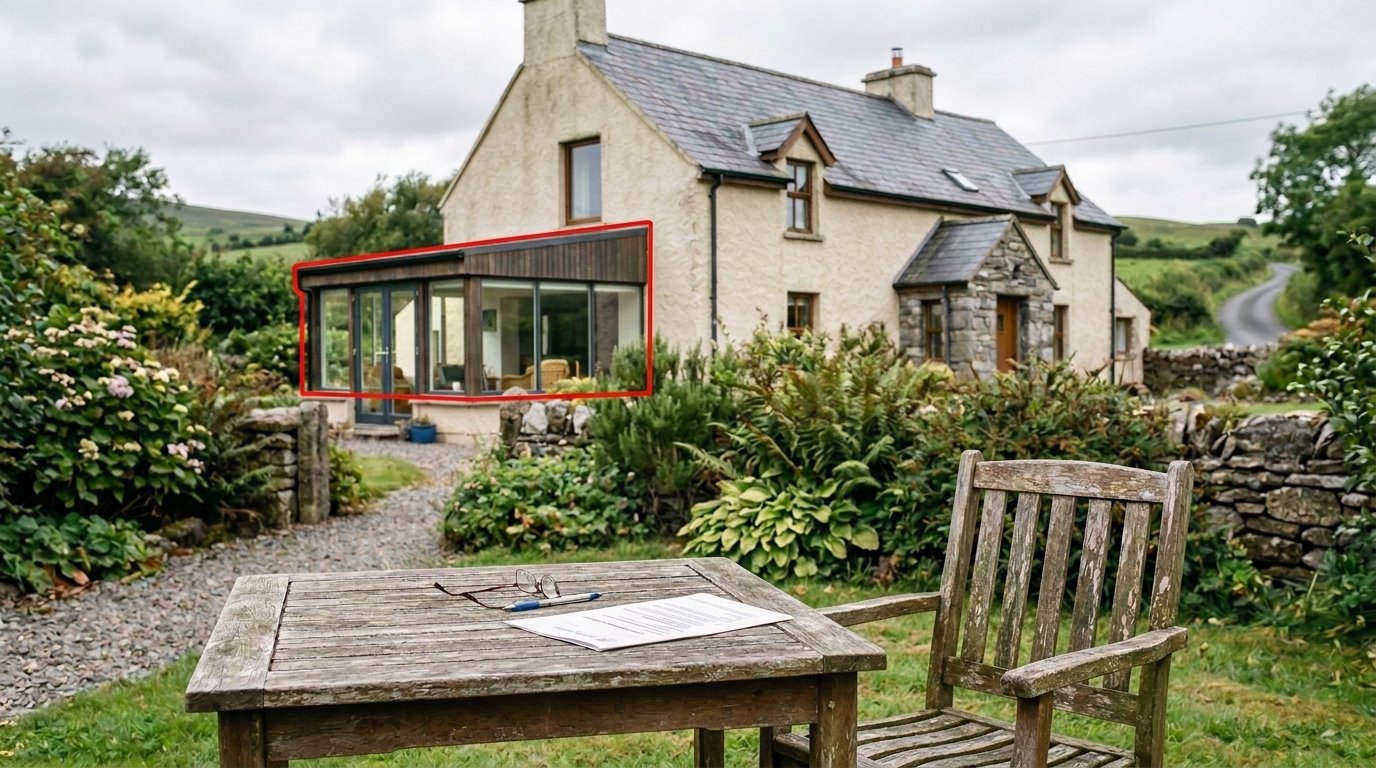
Built Without Planning Permission? Planning Enforcement and Retention in Ireland
If building works have been carried out without planning permission, or if a warning letter has arrived from the local authority, quick action matters. In Ireland, planning enforcement can move from a complaint to a warning letter, then to an enforcement notice, and in some cases on to court action.
The good news is that not every breach becomes a disaster. Some unauthorised development can be regularised through retention permission, while other cases are better resolved by removing or altering the works. The key is to understand the position early, before the problem escalates.
What is unauthorised development?
Unauthorised development is any development that needed planning permission but was carried out without it, or development that was carried out in breach of an existing permission.
The word “development” is broad. It includes building, demolition, alterations, and a material change of use of land or a structure. That means an attic converted into a separate flat, a shed turned into a dwelling, or an extension built beyond exempted limits may all amount to unauthorised development.
Planning enforcement only applies where permission was actually required. If the works were exempted development, there is no breach for the planning authority to enforce. That is why it is so important to check the rules before starting work.
How does planning enforcement start?
Most planning enforcement cases begin with a complaint. Anyone who believes works are being carried out without permission, or contrary to permission, can contact the planning authority and explain the issue. These complaints are generally treated confidentially.
The council will usually review the complaint and may inspect the site. It also has discretion to decide that a complaint is frivolous, trivial, or without substance.
If the complaint is considered valid, the formal process usually begins with a warning letter.
Warning letter and enforcement notice
The planning enforcement process follows a defined timetable.
- A warning letter should normally issue within 6 weeks of the written complaint.
- You then have 4 weeks to respond.
- The council should reply to the complainant within 2 weeks after that response.
- The authority should decide whether further action is needed within 12 weeks of issuing the warning letter, where possible.
A warning letter is not a penalty in itself. It is an opportunity to put matters right before enforcement escalates. That may mean removing the works, applying for retention permission, or otherwise addressing the breach.
If the council confirms that unauthorised development has taken place and the issue has not been resolved, it may issue an enforcement notice.
An enforcement notice can require you to stop the development, remove or alter the structure, cease the use, or restore the land to its previous condition. It also warns that failure to comply may result in prosecution, council entry onto the land, remedial works carried out by the authority, and recovery of those costs from you.
In urgent cases, the council can issue an enforcement notice without first issuing a warning letter.
What are the penalties?
Penalties for breaching planning law are set out in the Planning and Development Act 2000, as amended. Depending on the offence, they can include a substantial fine, imprisonment, or both.
If the council carries out remedial works itself, the property owner may also be liable for those costs. In practice, that can make planning enforcement far more expensive than dealing with the issue early.
In more serious cases, or where the matter escalates, the council can seek an injunction from the Circuit Court or High Court under Section 160 of the Act. An individual or residents’ group can also seek such an injunction. That means planning enforcement can come not only from the local authority, but also from affected neighbours.
Is there a time limit on enforcement?
Yes, but with important exceptions. As a general rule, planning enforcement action for unauthorised development must begin within 7 years of the breach occurring.
There are three important points to understand.
First, the 7-year rule does not apply to every type of breach. In particular, a breach of a condition relating to the use of land may be enforced regardless of how much time has passed. Quarrying and peat extraction are also treated separately.
Second, the passage of 7 years does not make the development lawful. It only means it may no longer be enforceable. The structure may still create problems on sale, during legal due diligence, or in relation to other compliance issues.
Third, the Planning and Development Act 2024 is expected to change aspects of enforcement once its provisions are commenced. Those changes are not yet in force, so the current law remains the relevant position for now.
The 7-year rule should never be treated as a strategy. It is a legal backstop, not a planning solution.
Can I apply for retention permission?
Yes. If you discover that unauthorised development has already taken place, you may apply for retention permission to keep the development in place.
This is a legitimate route for regularising mistakes, but it has important limits:
- It is not guaranteed. A retention application is assessed as a fresh planning application against current policies and standards.
- The application fee is three times the normal planning fee.
- Applying for retention does not stop enforcement or prosecution if proceedings have already begun.
- Some development cannot be retained through an ordinary application, particularly where EIA screening or Appropriate Assessment under the Habitats Directive may be required.
If your works may fall into one of those categories, get professional advice before making any application.
How can I avoid planning enforcement?
The best way to avoid planning enforcement in Ireland is to check the rules before you build.
If you believe your works may be exempted development, make sure you are confident about the exemption limits. If there is any uncertainty, ask your local authority for a Section 5 declaration before starting work. That gives you a formal written decision on whether the works are exempt.
A Section 5 declaration costs far less than a retention application, enforcement proceedings, or the removal of a finished structure. In planning terms, it is often one of the cheapest forms of insurance available.
Frequently asked questions
What happens if I build without planning permission in Ireland?
You may be subject to planning enforcement, starting with a complaint and potentially progressing to a warning letter, enforcement notice, prosecution, or court action.
Can I apply for retention permission after receiving a warning letter?
Yes, in many cases you can. A warning letter is often the point at which people seek retention permission or other corrective action.
Does the 7-year rule make unauthorised development legal?
No. It may limit enforcement in some cases, but it does not make the development lawful.
Can the council force me to remove the works?
Yes. An enforcement notice can require removal, alteration, cessation of use, or restoration of the property.
Should I wait and see if anything happens?
No. Delay usually makes the problem worse, especially if the issue affects a sale, mortgage, dispute, or complaint from a neighbour.
When should I get advice?
If you receive a warning letter, read it carefully and note the deadlines immediately. In a minor case, you may be able to resolve the matter directly with the planning authority.
If you receive an enforcement notice, are considering retention permission, or suspect that EIA or Appropriate Assessment may be involved, professional advice is strongly recommended. Planning enforcement can become expensive quickly, and the cost of doing nothing is often far greater than the cost of getting advice early.
What to do if you are worried about unauthorised development
If you are worried that works on your property may have been built without planning permission, do not wait for the issue to escalate. Early advice can often reduce cost, limit risk, and help you choose the right route, whether that is retention permission, a Section 5 declaration, or a practical response to an enforcement letter.
If you need clear, experienced guidance on planning enforcement Ireland, retention permission, or unauthorised development, speak to a planning professional before the situation gets any harder to fix.