Vacant Property Refurbishment Grant Ireland 2026: A Complete Guide
The Vacant Property Refurbishment Grant Ireland 2026 can pay up to €50,000 towards bringing a vacant home back into use, rising to €70,000 if the property is derelict. It is one of the more generous home improvement grants available in Ireland, but also one of the most misunderstood. The eligibility rules are specific, documentation requirements are detailed, and the grant sits alongside planning and Building Regulation requirements.
This guide explains who qualifies for the vacant property refurbishment grant in Ireland in 2026, what the grant actually pays for, and how it interacts with planning permission and Building Regulations.
Figures in this article reflect the scheme as published by the Department of Housing, Local Government and Heritage, last updated 1 April 2026. Grant schemes are reviewed periodically — always confirm the current position on gov.ie before committing to a budget.
What Is the Vacant Property Refurbishment Grant?
The Vacant Property Refurbishment Grant (VPRG) is administered by local authorities under the Croí Cónaithe (Towns) Fund. It provides financial support to people who want to refurbish a vacant or derelict property and turn it into either their principal private residence or a rental property with a registered tenancy.
The grant is also available where an entire former commercial or public-use building is being converted into residential units.
The grant is not a loan and does not need to be repaid, provided you meet the scheme conditions and comply with any clawback requirements if you sell or stop using the property within the specified period.
Who Qualifies in 2026?
To qualify for the vacant property refurbishment grant Ireland 2026, three core conditions apply:
- You must have proof of ownership of the building, or evidence of active negotiations to purchase the property.
- The property must have been vacant for at least two years at the time of application, and it must have been built before 2008.
- Applications can only be made by named individuals — it is not available to registered companies.
The grant applies to qualifying properties across cities, towns, villages, and rural areas. There is no geographic restriction beyond the property itself meeting the vacancy and age criteria.
You must ultimately either live in the refurbished property as your principal home or rent it out and register the tenancy with the Residential Tenancies Board, normally for at least five years after the grant is paid.
How Much Does the Grant Pay?
The scheme has several tiers. Understanding the difference between vacant and derelict, and between a single dwelling and a multi-unit conversion, is crucial to knowing how much funding is available.
Standard Vacant Property Refurbishment Grant: up to €50,000, inclusive of VAT, for a property that is vacant but not derelict. The amount is subject to upper limits for different categories of work and a reasonable cost assessment by the local authority. You do not automatically receive the maximum.
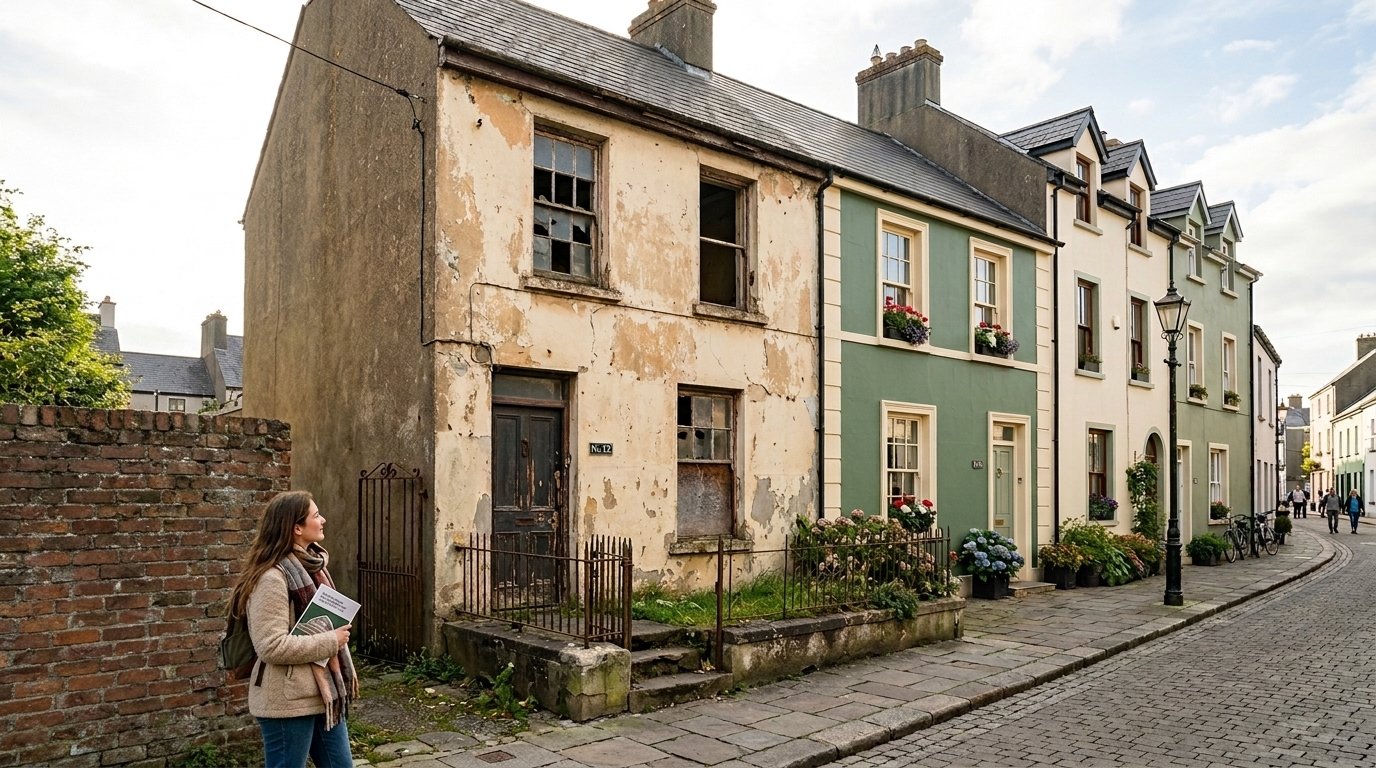
Derelict Property Top-Up: where the property is confirmed to be derelict — either by an independent report confirming it is structurally unsound and dangerous, or because it is already on the Derelict Sites Register — a top-up of up to €20,000 is available, bringing the total available for a derelict property to €70,000.
Conversion of a former commercial or public-use building
Where an entire former commercial or public-use building is being converted into multiple residential units, further top-ups apply on top of the standard or derelict rates:
- Up to €20,000 extra where two residential units are created.
- Up to €40,000 extra where three or more residential units are created.
This can bring the maximum package to:
- €70,000 for a vacant (non-derelict) former commercial building where two units are created, and €90,000 where three or more units are created.
- €90,000 for a derelict former commercial building where two units are created, and €110,000 where three or more units are created.
What Documentation Do You Need?
Local authorities require a defined set of supporting documents. Getting these in order before you apply will save time and reduce the risk of delays. Expect to provide:
- Proof of vacancy — evidence the property has been unoccupied for at least two years (for example utility bills, local authority records, or other documentation).
- Proof of ownership, or clear evidence of active negotiations to purchase (such as correspondence from an estate agent or owner).
- A quotation for the proposed works from a contractor, covering the scope you intend to carry out.
- An independent structural report confirming the property is structurally unsound and dangerous, if you are seeking the derelict top-up and the property is not already on the Derelict Sites Register.
- Any further documentation your local authority requests to support the application.
There are two separate application forms: one for the refurbishment of a single vacant or derelict dwelling, and a distinct form for the conversion of a former commercial or public-use building into two or more residential units. Using the wrong form is a common and avoidable cause of delay.
Does the Grant Cover Planning Permission and Building Regulations?
No — and this is where the Vacant Property Refurbishment Grant Ireland 2026 most often intersects with planning.
The grant pays towards the cost of construction works. It does not grant planning permission, remove the need for planning permission where required, or replace Building Regulations compliance.
If the refurbishment involves works that require planning permission — for example a change of use where the building was not previously residential, a material alteration to a protected structure, or an extension beyond exempted limits — permission must still be obtained through the normal process, independently of the grant application.
The same is true of Building Regulations. Refurbishing a long-vacant property very often means bringing an older building up to current standards on structure, fire safety, ventilation, and energy performance — none of which the grant assessment substitutes for. See our guide to retrofitting a home in Ireland if the refurbishment overlaps with an SEAI-grant-aided energy upgrade — the two grant schemes are separate and are not mutually exclusive, but each has its own rules and its own clock.
If the property is a protected structure, or the vacant building sits in a town-centre Architectural Conservation Area — which is not unusual for older vacant stock — assume that planning permission will be required for most works and engage a conservation-aware architect before seeking quotations.
A Practical Sequence for Vacant Property Projects
Because grant, planning, and building control all overlap, it helps to follow a clear sequence:
- Confirm ownership or agree terms to purchase, and gather proof of the property’s vacancy period.
- Get an independent structural assessment if you believe the property qualifies as derelict — this affects which grant tier applies and which application form you use.
- Establish the planning position for the works you intend to carry out. Do not assume refurbishment of a vacant building is automatically exempt. A change of use from a former commercial building, in particular, is unlikely to be.
- Obtain a written quotation for the works from a contractor, reflecting the confirmed scope and any planning constraints.
- Apply to your local authority using the correct form for your situation and include all supporting documentation.
- Treat grant approval and planning separately — grant approval does not mean planning permission or Building Regulations compliance have been satisfied. They are assessed independently, by different teams, under different legislation.
If you are assembling a scope of works and a rough layout to support your grant application or discuss the project with an architect, sketching the existing and proposed layout clearly helps at this stage. SketchUp is a reasonably accessible tool for producing simple layout sketches before you commission full professional drawings.
When Should I Get Professional Advice?
Professional advice is worth seeking before you apply if:
- The property is a protected structure, or you suspect it might be — both the planning position and realistic cost of works change significantly in this scenario.
- You are converting a former commercial or public-use building, where the change of use itself is likely to need planning permission as a separate matter.
- The structural condition of the property is genuinely uncertain — the independent assessment required for the derelict top-up should come from a qualified professional in the form of a written report.
- You plan to combine the Vacant Property Refurbishment Grant with SEAI energy upgrade grants and need help sequencing applications and works so you do not inadvertently disqualify one of the schemes.
Frequently Asked Questions
Do I need planning permission to use the Vacant Property Refurbishment Grant?
You can apply for the grant without having planning permission in place. However, if the works you carry out with the grant require planning permission — for example a change of use or works to a protected structure — that permission is a separate requirement and must be obtained independently.
Can a company apply for the Vacant Property Refurbishment Grant?
No. Applications can only be made by named individual owners. The scheme is not available to registered companies.
How long does a property need to be vacant to qualify?
The property must have been vacant for at least two years at the time of application and must have been built before 2008.
Is the Vacant Property Refurbishment Grant the same as SEAI retrofit grants?
No. They are separate schemes with separate rules. A refurbishment project can often use both where the works qualify for each, but sequencing matters — see our guide to retrofitting a home in Ireland for how to avoid losing either grant by getting the order wrong.
Key Takeaways
- The Vacant Property Refurbishment Grant Ireland 2026 pays up to €50,000 for a vacant property, rising to €70,000 if derelict, with higher tiers for multi-unit commercial conversions.
- Eligibility requires the property to be vacant for 2+ years, built before 2008, and the application to be made by a named individual, not a company.
- The grant covers approved construction costs only — it does not grant planning permission or remove the need for Building Regulations compliance.
- Converting a former commercial building is especially likely to need planning permission for the change of use itself, separate from the grant.
- Applications go through your local authority, using the correct form for either a single dwelling or a multi-unit commercial conversion.
This article is general guidance for homeowners in the Republic of Ireland. It is not legal, financial, or planning advice. Grant values, eligibility criteria, and scheme rules change — always confirm the current position with your local authority and gov.ie before committing to a project budget.