Site Suitability Tests in Ireland: Why Your Dream Site Might Fail (and What to Do About It)
Buying a rural site for a one-off house can look straightforward until the question of site suitability tests and on-site waste water treatment appears. If the ground cannot support a suitable on-site treatment system, planning permission may be difficult to secure, even where the location, design, and local need case are otherwise strong.
That is why a site suitability test in Ireland should be treated as early due diligence, not as a technical box to tick later. For many buyers, the real question is not whether the site looks good on a map, but whether it can safely deal with wastewater in a way the planning authority is likely to accept.
If you are thinking of buying a rural site, commission the test before you buy. It is one of the clearest ways to avoid paying full price for land that may be costly, constrained, or difficult to build on.
This issue mainly affects rural sites without access to a public sewer. If a sewer connection may be available, confirm that point early with the relevant authority before assuming you need an on-site system.
Why This Test Matters So Much
A lot of self-builders focus first on frontage, views, orientation, and local need. Those things matter, but wastewater can still stop the project before it starts.
A site can look ideal on paper and still turn out to be problematic because:
- the soil drains too slowly,
- groundwater may be too high,
- the site may not have enough usable area,
- or nearby wells and watercourses may limit what can be installed.
That is why the timing matters. Before purchase, a poor result is useful information. After purchase, it becomes your problem.
What Is a Site Suitability Test?
A site suitability test is an assessment of whether a site is likely to accommodate an on-site wastewater treatment system for a single house. Many people still refer to it as a percolation test, but the full assessment is broader than that.
Where a rural one-off house will not connect to a public sewer, a site suitability assessment is usually required as part of the planning process. It is normally carried out by a competent professional, often a civil or environmental engineer, and the results are submitted with the planning application.
The assessment is generally carried out in line with the EPA’s Code of Practice for domestic wastewater treatment systems. Local authorities usually review the results against that guidance, along with any relevant development plan policies.
What Does the Assessment Usually Involve?
A site suitability assessment is not based on one hole in the ground or one number on a form. It usually involves a combination of soil inspection, percolation testing, and checks on groundwater conditions and site constraints.
Visual Soil Assessment
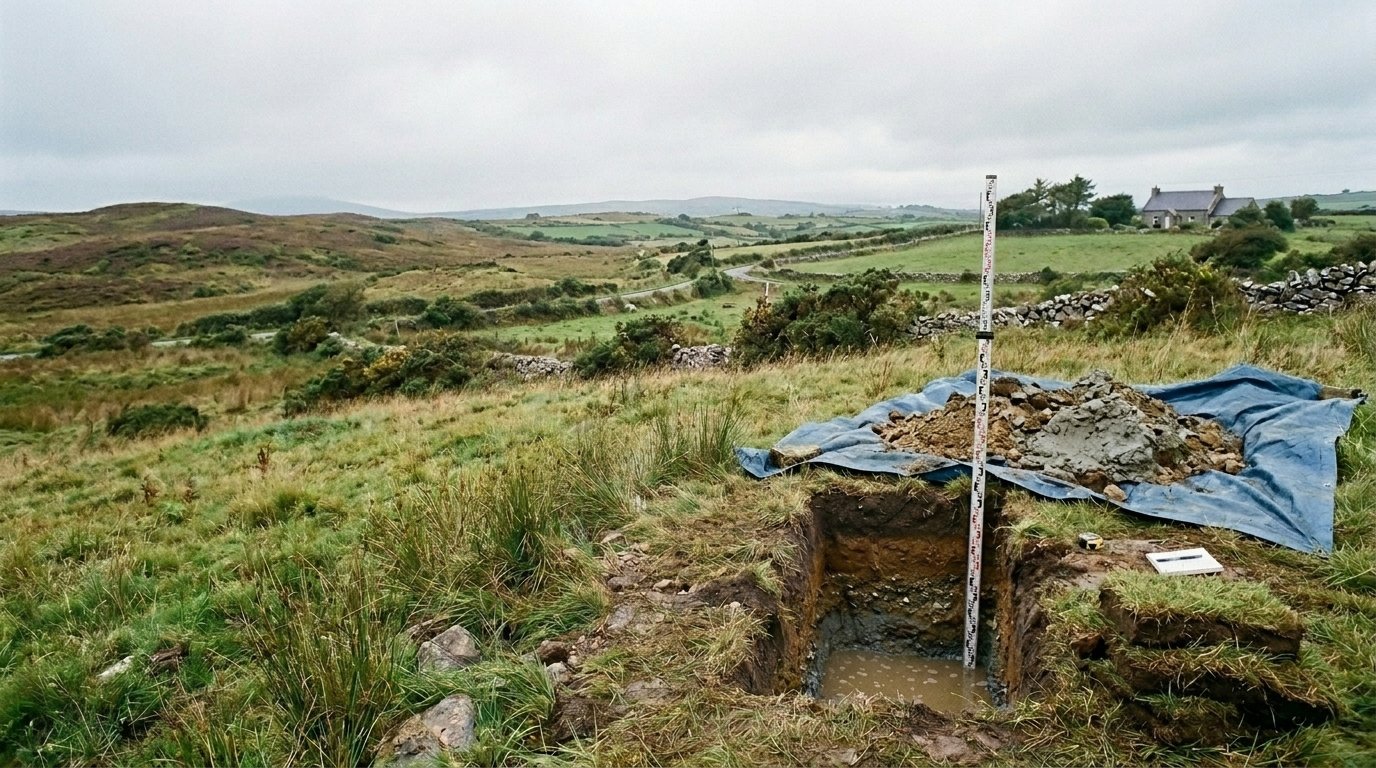
Trial holes are opened in the proposed treatment area so the assessor can examine the soil profile. The purpose is to understand what kind of subsoil is present, how freely it drains, and whether there are signs of seasonal waterlogging, shallow bedrock, or other constraints.
The assessor will usually look at:
- soil type and structure,
- colour and mottling,
- depth to rock,
- groundwater indicators,
- and the amount of usable subsoil available.
A site that appears dry at the surface can still show signs of wetness lower down. That is one reason apparently good sites sometimes produce disappointing results.
Percolation Testing
The percolation element of the assessment measures how quickly water moves through the ground. This produces a T-value, which helps indicate whether the soil may be suitable for a standard wastewater solution or whether a different approach might be needed.
In broad terms:
- very slow-draining ground can be a problem,
- very fast-draining ground can also be a problem,
- and an acceptable middle range is generally needed for conventional solutions.
The exact interpretation depends on the site conditions, the proposed treatment system, and the current EPA guidance. That is why the result should be read as part of the full assessment, not in isolation.
Groundwater and Separation Checks
The assessor will also consider groundwater depth and the available separation between the treatment area and sensitive features such as wells, watercourses, boundaries, and the proposed house.
This part of the exercise often becomes the deciding factor on tighter or more constrained sites. A site may have workable soil in one sense, but still fail to provide enough room for a compliant layout.
Why Sites Fail
Most failed site suitability tests in Ireland come down to one or more recurring problems.
High Groundwater
If groundwater is too close to the surface, there may not be enough unsaturated subsoil available to treat wastewater safely before it reaches the water table.
Poor-Draining Soil
Heavy clay or similarly impermeable ground may drain too slowly for a conventional polishing filter to work properly.
Very Free-Draining Ground
At the other end of the scale, water may move through the soil too quickly, which can reduce the treatment effect of the soil and raise environmental concerns.
Not Enough Usable Space
Even if the ground conditions are reasonable, the site still needs enough room to fit the treatment area while keeping suitable separation distances from:
- wells,
- watercourses,
- boundaries,
- access points,
- and the house itself.
This is where small or awkwardly shaped sites often run into trouble.
Sensitive Features Nearby
A nearby well, stream, lake, wetland, or groundwater-sensitive area may reduce what is acceptable on the site. In some cases, the issue is not whether treatment is technically possible, but whether the planning authority is likely to accept the risk.
What a Failed Result Means in Practice
A failed or marginal result does not always mean the site is worthless. It usually means the standard solution may not be acceptable in its current form.
That can lead to several outcomes:
- a more advanced and more expensive treatment system,
- a redesign of the house and treatment layout,
- a reduction in the usable development area,
- or, in some cases, the conclusion that the site is not a realistic candidate for a one-off house.
This is the commercial point many buyers miss. The test does not just answer a technical question. It changes the risk profile and, potentially, the value of the site.
A marginal site may still be buildable, but it is not the same proposition as a straightforward site with a clean result. That difference should be reflected in the price.
What Can Be Done If the Site Is Marginal or Fails?
Alternative Treatment Systems
Some sites may still work with a more advanced treatment solution or a raised system. That can improve the quality of discharge, but it usually adds cost, maintenance obligations, and sometimes more planning scrutiny.
Repositioning the Layout
Ground conditions are not always uniform across a site. In some cases, moving the house or the treatment area can improve the outcome.
Checking for Sewer Connection Options
If a public sewer is available within a realistic distance, connection may remove the problem altogether. This should be confirmed early rather than assumed.
Revisiting the Deal
Sometimes the smartest decision is not technical at all. It is commercial. If the site is constrained, that should affect the price. If the risk feels too high, walking away may be the better decision.
When Should You Commission the Test?
Ideally, before signing a contract to buy the site.
This is when the information has the most value. Before purchase, you can:
- renegotiate the price,
- make the deal conditional,
- ask better questions,
- or decide not to proceed.
After purchase, the result becomes a cost and risk issue rather than a decision-making tool.
That is the sharper truth behind this entire topic: many self-builders spend months thinking about house design before confirming whether the site is even likely to work from a wastewater point of view.
Does a Pass Guarantee Planning Permission?
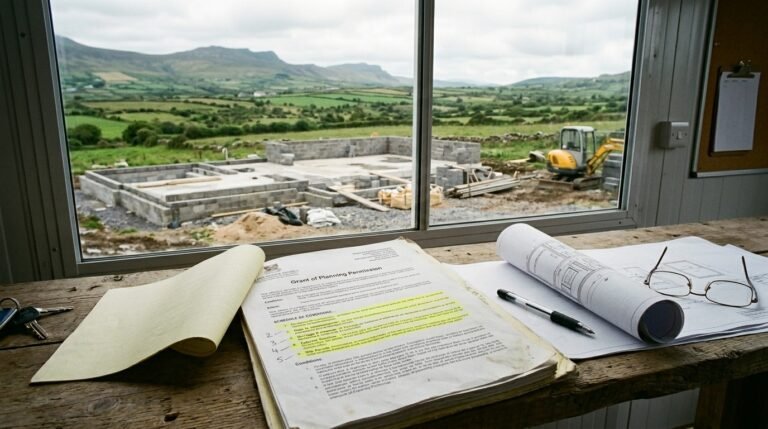
No. A satisfactory site suitability assessment removes one important obstacle, but it does not guarantee planning permission.
The planning authority may still look at:
- local needs criteria,
- road access and sightlines,
- visual impact,
- design quality,
- compliance with the county development plan,
- and other environmental or policy constraints.
A good site suitability result is helpful. It is not the whole planning case.
What Should You Ask Before Commissioning the Test?
Before engaging an engineer or assessor, it is worth asking:
- Have you assessed sites in this area before?
- What local soil or groundwater issues are common here?
- How many test locations will be examined?
- If the result is marginal, what alternatives might be explored?
- What report format does the local authority usually expect?
- Will the report explain the implications clearly if the site does not achieve a straightforward result?
A useful report should do more than say pass or fail. It should help you understand the level of risk and what your options are.
Frequently Asked Questions
What is a site suitability test in Ireland?
It is an assessment of whether a site is likely to accommodate an on-site wastewater treatment system for a single house.
Is a percolation test the same as a site suitability test?
Not exactly. A percolation test is one part of the wider site suitability assessment, which also looks at soil profile, groundwater, depth, layout constraints, and separation distances.
Can a site fail even if it looks dry?
Yes. A site can appear dry on the surface and still have unsuitable subsoil or seasonal groundwater issues below ground.
Can a failed site still get planning permission?
Sometimes, depending on the reason for the failure and whether an acceptable alternative wastewater solution is available.
When should I get a site suitability test done?
Ideally before you buy the site, or at the very least before spending significant money on a planning application.
Final Thought
A rural site is not really proven until the wastewater question has been tested properly. Views, road frontage, and a good price can all be persuasive, but they do not tell you whether the site is likely to work in planning terms.
If you are considering buying land for a one-off house, treat the site suitability assessment as an early decision tool, not a late technical formality. It is one of the clearest ways to avoid paying too much for the wrong site.