Planning Conditions That Kill Self-Build Projects (and How to Spot Them Early)
Getting planning permission is one thing. Reading the grant carefully is another. The two steps are not the same.
A grant of planning permission does not simply say yes to your project. It says yes, subject to conditions. Some of those conditions are straightforward. Others can add months to your timeline, thousands of euros to your costs, or — in the worst cases — make the approved design unworkable in practice.
This article explains the types of conditions that most commonly cause problems for self-builders, what they mean in practice, and how to spot them before they catch you off guard.
What Is a Planning Condition?
A planning condition is a requirement attached to a grant of planning permission under Section 34 of the Planning and Development Act 2000 (as amended). Every grant includes a schedule of conditions that must be complied with. There is no grant without conditions.
Conditions broadly fall into three types:
Pre-commencement conditions must be complied with before any work starts on site. You cannot legally commence development until these conditions have been discharged.
Ongoing conditions must be complied with during construction — specifying materials, construction methods, working hours, or requiring notification of the local authority at particular stages.
Completion conditions must be satisfied before the development can be occupied or used — for example, a condition requiring landscaping to be installed before you move in.
The distinction matters. A pre-commencement condition that requires you to commission a report, obtain approval from a specialist, or make a financial payment can add weeks or months to your start date if you have not anticipated it.
Pre-Commencement Conditions: The Most Common Delay
Pre-commencement conditions stall projects because the builder or site owner assumes that a grant of planning permission means work can begin. It does not.
Sample condition (materials): “Prior to the commencement of development, the applicant shall submit to, and obtain the written approval of, the planning authority details of the proposed external finishes, including facing materials, roof coverings, and window frames. Development shall then proceed in accordance with the approved details.”
This type of condition does not prevent development indefinitely — the local authority has a statutory time period in which to assess your submission. However, preparing the submission, submitting it, waiting for a response, and incorporating any feedback takes time. If you have contractors booked, the delay has a cost.
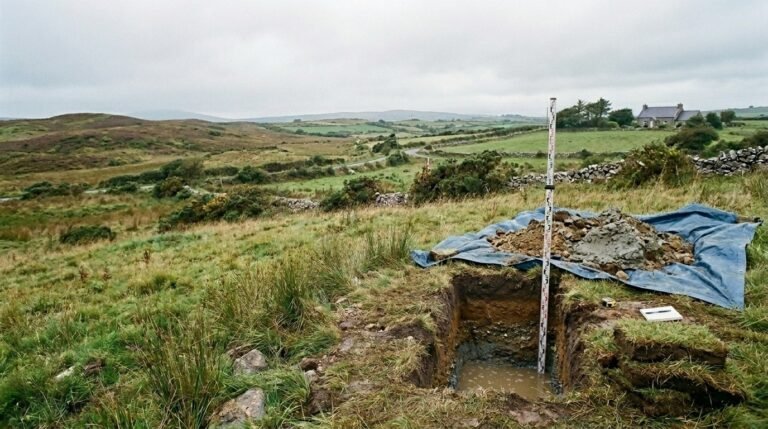
Sample condition (pre-commencement archaeology): “Prior to the commencement of development, the applicant shall carry out a programme of archaeological testing in accordance with a methodology to be agreed in writing with the planning authority. Development shall not commence until the results have been submitted and approved by the planning authority.”
An archaeology condition at pre-commencement stage can stall a project for a substantial period. The methodology must be agreed, the testing carried out by a licensed archaeologist, a report prepared and submitted, and approval obtained. In areas of known archaeological sensitivity, the testing may reveal features that require further investigation or monitoring during construction.
If archaeological testing is a pre-commencement requirement on your site, engage a licensed archaeologist immediately after grant and before you finalise your programme. Do not assume it is a box-ticking exercise. Some testing programmes run for months.
Development Contributions: The Costs Many Self-Builders Do Not Anticipate
Development contributions are levies payable to the local authority as a condition of planning permission, under Section 48 of the Planning and Development Act 2000. They represent the applicant’s contribution towards the infrastructure costs associated with development — roads, drainage, public open space, community facilities.
The contribution is calculated by reference to the local authority’s development contribution scheme, which is adopted periodically by each council. The rate varies by local authority, by development type, and sometimes by location within the county. For a one-off rural house in 2025, a development contribution commonly falls in the range of €5,000 to €15,000, though figures outside this range are possible and you should check the relevant scheme for your county.
The condition will typically state that the contribution must be paid before the commencement of development or at a specified stage. Some local authorities allow payment to be deferred to completion, but this is not universal.
Development contributions are not optional. They are a condition of the grant and must be paid to comply with it. Do not proceed to tender or sign a building contract without accounting for them in your budget. A self-builder who plans to proceed immediately after grant and discovers a €10,000 payment is required before day one has a cash flow problem.
Archaeology: When the Ground Has Other Plans
Archaeological conditions are more common in rural Ireland than many applicants expect. The existence of recorded monuments, the proximity of townland boundaries historically associated with settlement, or the general character of the landscape can all generate a requirement for archaeological input.
Conditions vary in what they require:
- A watching brief requires a licensed archaeologist to be present during topsoil stripping and any significant groundworks, with authority to halt work if features are found.
- Pre-commencement testing requires investigation before work starts, as described above.
- A full excavation can be required where testing reveals significant archaeological features.
A watching brief is the least disruptive — the archaeologist monitors rather than directing. Pre-commencement testing adds a programme of work before you can start. A full excavation adds a significant unknown: you do not know the extent of the feature until you have investigated it.
Budget for an archaeological watching brief on any rural site in an area with known monument density. If your grant includes a testing condition, engage a licensed archaeologist before you finalise your programme and get a realistic timeline from them.
Road and Access Conditions
Local authorities regularly impose conditions requiring works to the public road as part of granting permission for a rural house. These are usually about sight distances — the length of visibility available in both directions from your access onto the road.
A typical condition might require:
- Vegetation to be removed from road verges to achieve required sight lines.
- A road entrance to be constructed to the local authority’s standard specification before the dwelling is occupied.
- A turning area within the site to be completed before occupation.
- Boundary treatments along the road frontage to be set back to achieve the required sight distance.
These conditions are usually in the applicant’s control to discharge. However, sight line requirements sometimes require land outside your boundary — for example, clearing vegetation on the road verge. The road verge is public land, but achieving the sight line still requires engagement with the local authority’s roads department, and in some cases a formal licence.
On regional or national roads, road opening or junction improvement works may be required and must meet Transport Infrastructure Ireland (TII) standards. Where a condition requires works to a national road, you will need a Road Opening Licence from TII, not just the local authority. This adds a separate approval process.
Landscaping and Ecological Conditions
Landscaping conditions require a specified scheme of planting to be installed, usually before occupation or within a fixed period of completion. They are relatively straightforward to discharge but require planning.
Ecological conditions are worth taking seriously. Where a survey identified bat roosts, nesting birds, or protected plant species, the grant may include:
- A condition requiring works to be carried out outside the bat maternity season (typically April to August).
- A condition requiring supervision by an ecologist during works affecting potential nesting habitat.
- A condition prohibiting felling, scrub clearance, or soil stripping during the bird nesting season (typically March to August).
These seasonal restrictions are not negotiable. Breaching them can constitute an offence under wildlife legislation as well as a breach of planning conditions.
How to Read a Grant of Planning Permission
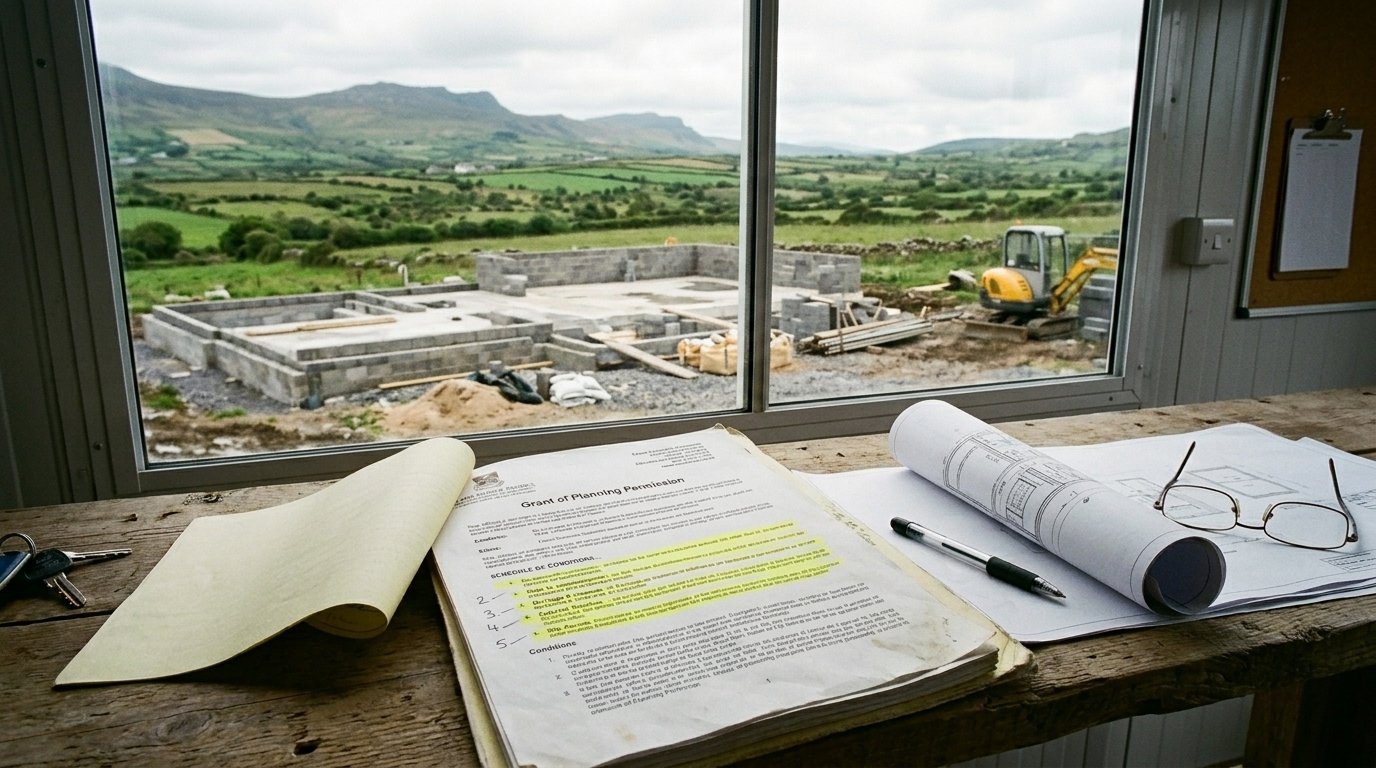
The grant document from your local authority contains the planning reference number, the description of the approved development, and the schedule of conditions. The schedule is what matters.
Read every condition before you do anything. Ask yourself:
- Which conditions must be discharged before I can start?
- Which conditions require submissions to be made and approved?
- What does each condition require me to do, and what will it cost?
- Are any conditions capable of being complied with on the day of commencement, or do they require prior engagement with third parties?
Where a condition is unclear, you can ask the planning authority for clarification in writing. Where a condition is onerous or incorrect, there is an appeal mechanism — conditions can be the subject of a third-party appeal to An Bord Pleanála within the appeal period, and an applicant can appeal specific conditions without appealing the grant itself.
However, the time to read and, if necessary, challenge conditions is within the appeal period — typically four weeks from the date of grant. Do not allow that window to pass without reading the conditions in full.
Discharging Conditions
Once the works or submissions required by a condition are complete, you notify the local authority and formally request a written confirmation that the condition has been discharged. This is sometimes called a compliance submission or pre-commencement condition discharge application, depending on your local authority’s terminology.
Keep records. Your solicitor and any future purchaser of the property will want to see evidence that conditions were complied with. A well-organised folder — even a simple envelope with printed confirmations — is worth maintaining from the outset.
When Should I Get Professional Advice?
If you have received a grant of planning permission, have your architect or planning consultant read the conditions with you before you proceed. Their job does not end when the grant arrives.
Pre-commencement conditions in particular need to be factored into your programme. An architect managing a self-build project will typically take responsibility for preparing and submitting condition compliance submissions — but only if they know what is required. Read the conditions with them, agree who is responsible for each, and build the compliance timeline into your construction programme.
If your grant includes archaeological, road, or ecological conditions, engage the relevant specialist early. These are the conditions that most commonly delay otherwise well-prepared projects.
Key Takeaways
- A grant of planning permission is not a green light to start work. Read the Schedule of Conditions first.
- Pre-commencement conditions must be discharged before work begins. They can take weeks to months.
- Development contributions must be budgeted from the outset — check your local authority’s scheme before you receive the grant.
- Archaeology conditions are more common in rural Ireland than many expect. A pre-commencement testing requirement adds a genuine programme to your timeline.
- Road and access conditions may require engagement with the roads department or TII, not just the planning authority.
- Ecological conditions include seasonal restrictions that are legally enforceable regardless of your construction programme.
- The four-week appeal period is the time to read, understand, and if necessary challenge conditions.